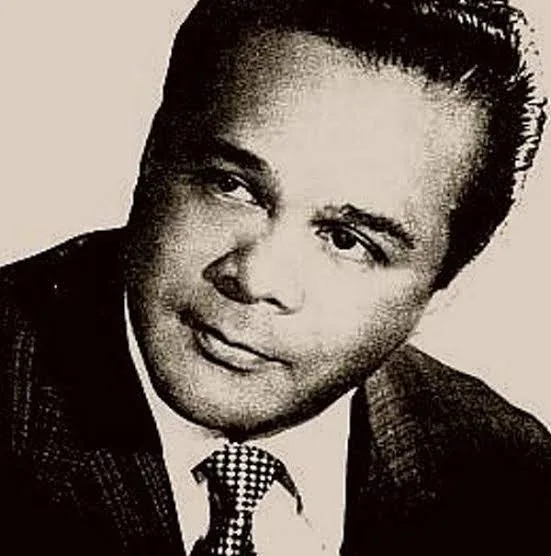
Antonio Arcaño Betancourt was born on December 29, 1911, in the Atarés neighborhood of Havana. While still a child, his family moved to the seaside town of Regla. He began his musical studies, learning solfège and music theory under the tutelage of Armando Romeu. His cousin, José Antonio Díaz Betancourt, taught him to play the five-key flute.
Arcaño began his career as a musician, substituting for his cousin at some dances. He made his first public appearance at the La Bombilla cabaret, and later also performed at the La Panera cabaret in Monte Carlo.
Beginning in the 1930s, he worked with the Galatea dance academy orchestra, playing alongside renowned musicians such as Silvio Contreras, Miguel Valdés, and Orestes López. He then joined Armando Valdespí's orchestra, where he remained until the mid-1930s, when he joined Armando Valdés Torres's Orquesta Gris.
In 1935, Arcaño was the musical director of the Maravilla del Siglo orchestra, which was founded by the singer and guitarist Fernando Collazo. Ricardo Reverón, Rodolfo O'Farril, and Ulpiano Díaz, among others, also worked in the orchestra.
In 1937, Arcaño organized his own orchestra, La Maravilla de Arcaño, comprised of some of the musicians from La Maravilla del Siglo, its predecessor. It also included musicians from the Sport Antillano Dance Academy Orchestra. The orchestra consisted of: Antonio Arcaño (director and flute), Jesús López (piano), Elizardo Aroche and Raúl Valdés (violins), Israel López (Cachao) (double bass), Ulpiano Díaz (timbales), and Oscar Pelegrín (güiro). During this period, Miguelito García, René Márquez, René Álvarez, Gerardo Pedroso, Rafael Ortiz (Mañungo), and Miguelito Cuní sang with the orchestra.
In the early 1940s, the orchestra began to be called Arcaño y sus Maravillas. During this period, they eliminated the singers, as the danzones they performed were purely instrumental.
Each musician in Arcaño's group stood out for their virtuosity and achieved a cohesion in their performances that was uncommon in groups of the time.
Arcaño introduced the conga drum to the orchestra, an innovation for this type of instrumental format, thus perfecting the rhythmic foundation required by the new Danzón rhythm. It was played by Eliseo Pozo (El Colorao). This introduction of the conga drum was imitated by all the other charanga orchestras.
Arcaño's orchestra participated in the inauguration of radio station Mil Diez. For their radio appearances on the station, the orchestra was called Radiofónica. Sometimes other instruments were added to create different timbres and also due to the complexity of the arrangements.
The Arcaño y sus Maravillas orchestra, as it was later known, only played for the aforementioned radio station. Due to its popularity, the group performed at all the social clubs and high schools of the time. The orchestra had a wide repertoire that included versions of many works from the symphonic repertoire, showcasing high quality and a high degree of originality. Arcaño y sus Maravillas played its last dance in Alquízar in 1958. With his orchestra, he achieved great success and contributed to the development of popular music in Cuba.
Later, Arcaño dedicated his final years to teaching music in labor unions and music schools, and to training new Danzón performers. He contributed to the development of many young talents in Cuban music. He also collaborated with the Cuban Music Seminar at the Center for Folkloric Research, directed by pianist and musicologist Odilio Urfé, and with the Recording and Musical Editions Company, EGREM (Recording Studios, Calle 18 No. 103 between 1st and 3rd, Miramar, Havana).
Antonio Arcaño Betancourt passed away in 1994 in Havana.
He is considered one of the four greatest Danzón flutists in Cuba, because his flute playing was exceptional. He possessed the remarkable ability to play his flute in perfect tune, a feat many flutists could not achieve. His improvisations were also precise and fresh. He marked a prestigious era in the history of Danzón in Cuba.