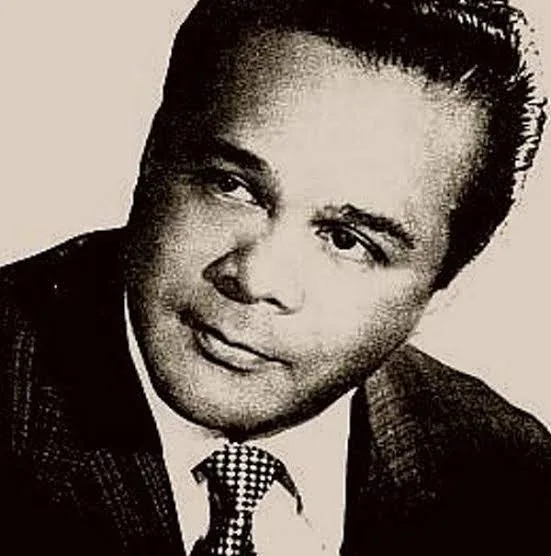
Bartolomé Maximiliano Moré Gutiérrez, known as Benny Moré, was born in August 1919 in the Pueblo Nuevo neighborhood of Santa Isabel de Las Lajas, a city located in what is now Cienfuegos Province. He came from a humble farming family. He was the eldest of 18 siblings. He was born out of wedlock; his mother's name was Virginia and his father was Silvestre Gutiérrez.
He learned to play the guitar as a child. At a very young age, he left school to work in the fields. At only 16, he joined his first musical group. In 1936, he left his hometown and traveled to Havana, where he worked selling spoiled fruits and vegetables, as well as medicinal herbs. Months later, he returned to his hometown and worked cutting sugarcane with his brother Teodoro. With his earnings and his brother's savings, he bought his first decent guitar.
He returned to Havana in 1940. He played in bars and cafes and then passed the hat. He lived in very poor conditions.
In the early 1940s, radio station CMQ had a program called Supreme Court of Art. The winners were hired and given the opportunity to record and perform their songs. His first performance was unsuccessful, but Benny didn't give up and auditioned again, this time winning first prize.
After that performance, he landed his first steady job with Conjunto Cauto, directed by Mozo Borgellá. He also sang successfully on radio station CMZ with Lázaro Cordero's Sextet Figaro. He debuted with the Cuato Quartet in 1944 on radio station Mil Diez.
Benny Moré replaced Miguel Matamoros in a performance with Trío Matamoros, as Matamoros was unable to perform. As a result of this, Benny remained with the group for years. He replaced Miguel Matamoros as lead singer, while Matamoros dedicated himself exclusively to directing the ensemble.
In June 1945, he traveled with Conjunto Matamoros to Mexico. There, he performed at two of the most famous cabarets of the time, the Montparnasse and the Río Rosa. He also made several recordings. Moré remained in Mexico, even though Conjunto Matamoros returned to Havana. It was in Mexico that he adopted his stage name, at the suggestion of Rafael Cueto.
Benny married a Mexican nurse named Juana Bocanegra Durán in 1946. He performed for a time at the Río Rosa as part of the Dueto Fantasma with Lalo Montané. He also recorded the songs "Me voy pal pueblo" and "Desdichado" for RCA Victor, with Mariano Mercerón's orchestra. With Dámaso Pérez Prado, he recorded "Babarabatiri," "Anabacoa," "Locas por el mambo," "Viejo cañengo," "El suave," "Maria Cristina," and "Pachito eche," among others. He began to be known as the Prince of Mambo. He also recorded "Dolor Carabalí" with Pérez Prado, which Benny Moré himself considered his best recording with the King of Mambo.
Benny returned to Cuba in late 1950. He was already known in some Latin American countries, including: Mexico, Panama, Colombia, Brazil and Puerto Rico.
His first Cuban recording was the song "Bonito y Sabroso," which became his first hit in Cuba. He performed live for the radio station Cadena Oriental, traveling to Havana to record the song at the RCA studios. Around this time, he recorded many other songs, including "La Cholanguengue," "Candelina Alé," and "Rabo y Oreja."
He also worked for the radio station RHC Cadena Azul, with Bebo Valdés's orchestra, who introduced him to a new style called batanga. There, he was known as El Bárbaro del Ritmo (The Barbarian of Rhythm), a nickname given to him by the program's host, Ibrahim Urbino. He had the opportunity to record with the renowned Sonora Matancera.
Later, Moré was hired by Radio Progreso to perform with Ernesto Duarte's orchestra. He performed in dance halls, cabarets, and at parties. In 1952, he recorded with the Orquesta Aragón, which he helped to establish in Havana's music scene.
After breaking off his relationship with Ernesto Duarte, he decided to found his own orchestra in 1953. Benny Moré's Giant Band debuted on the radio program Cascabeles Candado on CMQ. It was made up of more than 40 musicians and was comparable in size to Xavier Cugat's big band.
In 1954, the band began to gain popularity, not only nationally but also internationally. Between 1956 and 1957, they toured Venezuela, Jamaica, Haiti, Colombia, Panama, Mexico, and the United States, where they performed at the Academy Awards ceremony. In Havana, they played in the most famous dance halls, such as La Tropical (Ave. 41 between 44 and 46, Playa, Havana). In 1960, they also began performing at the Night and Day cabaret.
Since 1956 he began recording the famous son montunos dedicated to different Cuban cities, such as “Manzanillo”, by Radamés Reyes; “Santiago de Cuba”, “Palma Soriano” and “Marianao”, by Ramón Cabrera, and by Benny Moré himself “Santa Isabel de las Lajas” and “Cienfuegos”.
Benny also worked in film, in the movies Angel Face (1946); Made-to-Measure Bride (1949); When Dawn Arrives or Fire in the Flesh (1949); and Fifth Courtyard (1956), although in many cases these were brief appearances, even without being included in the credits.
Benny possessed a crystalline timbre and a perfectly tuned tenor voice. He had the ability to produce rich, full tones and a marvelous capacity for improvisation. His physical presence, his bearing, his distinctive attire, and the choreography he developed before the public were essential elements of Benny's persona. Incredibly, he couldn't read music, but he played the guitar and the tres and knew, like no other, how to conduct his musicians.
Among his compositions we can cite the following works: How it was, Beautiful and tasty, Santa Isabel de las Lajas, How well you dance, and Cienfuegos, among many others.
He died in Cuba on February 19, 1963, from cirrhosis of the liver.
The "King of Rhythm," a great Cuban musician whose songs have traveled the world and are still listened to with pleasure and affection today. Moré was a master of all genres of Cuban music, but he particularly excelled in Son Montuno, Mambo, and Bolero.
In 2006 the film El Benny premiered, and he also appeared as a character in the novel La isla de los amores infinitos, authored by Daína Chaviano.