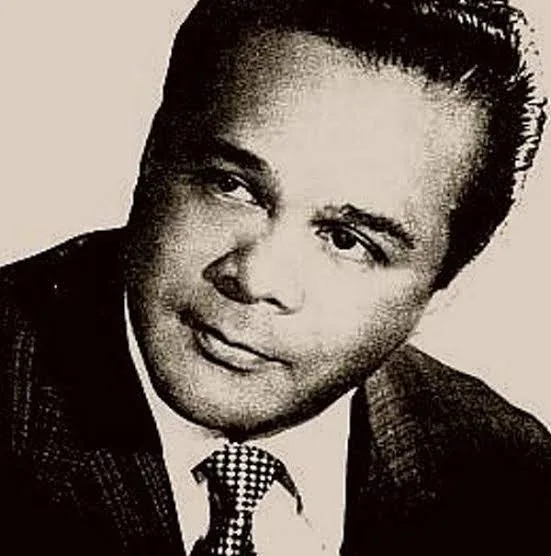
Dámaso Pérez Prado was born in December 1916 in the province of Matanzas. He studied music in his hometown with professors Rafael Somavilla Pedroso and María Angulo. He trained in composition and arrangement, and in piano.
He began his musical career as an instrumentalist in local orchestras. He worked as a pianist for Senén Suárez's Charanga orchestra.
In the early 1940s, Pérez Prado moved to Havana and settled there. He worked as a pianist in various orchestras, including Paulina Alvarez's ensemble, and at cabarets such as El Kursaal, El Panchín, and the Pennsylvania Cabaret. He also played with the orchestras of the Palau Brothers, Julio Cueva, Pildero's Cubaney, and CMQ. During this period, he was also the pianist for the Casino de la Playa group and briefly played with the Sonora Matancera.
His work with all these groups helped Dámaso develop his musical style. In 1944, he conducted his first musical experiments, attempting to fuse elements of jazz with Creole rhythms and melodies.
In 1945, he founded his first group, Conjunto Pérez Prado. With them, he recorded several albums for RCA Victor, none of which achieved significant success, with the exception of "El tumbaíto," featuring the vocals of Puerto Rican singer Mirta Silva. He traveled to Argentina and Venezuela, and later moved to New York City. While in New York, he created orchestrations for the Catalan violinist Xavier Cugat.
In 1948, disappointed that his experiments had not been successful on the Island and following the advice of Kiko Mendive, he changed his residence to Mexico City, with the purpose of creating a musical group there.
He began working as an arranger and pianist for several local orchestras until, aided by several renowned artists, including the Cuban actress and dancer Ninón Sevilla, he founded his own famous orchestra in 1950.
Dámaso's orchestra was comprised at different stages of, among others, of the following musicians: Clemente Piquero (Chicho), bongos; Ramón Santamaría (Mongo), congas; Chilo Morán, José Solís, Guadalupe Montes, Maynard Ferguson, Ray Triscari, Tony Facciuto, Donald Dennis, and Robert McKinziea, trumpets; Dave Sánchez and Milton Bernhart, trombones; René Bloch, Miguel Sánchez, Nash Maez, and Don Robinson, saxophones; Modesto Durán, Wilfredo Vicente, Eddie Gómez, and Leo Acosta, percussion; Marcus Morales and Carlos Sánchez, double bass; Joe Carioca, guitar; and Benny Moré, singer.
In 1951, he composed his first mambo, building upon earlier mambo-inspired forms by another Cuban musician, Orestes López, to create one of the most universal genres of Cuban music. Most of his mambos show a strong jazz influence, due to his time playing in bands that performed American music.
In that same year, Pérez Prado toured California and then the entire United States, which led to his group being described as the jazz orchestra with the most swing in the country.
He was the only conductor who, in his 1956 recordings, used two and later three trombones. He used them to achieve different effects, such as pedal points, or to emphasize changes and subdivisions of rhythm and tempo.
In 1963, Herman Díaz, a producer at RCA Victor, asked Pérez Prado to compose a symphonic work. Dámaso Pérez Prado's Exotic Suite of the Americas showcases the character of the music of the Americas. It premiered at the Theatre of the Americas in New York City. The work was recorded that same year in Hollywood. It is sixteen and a half minutes long and consists of seven movements.
The Cuban musician remained in the United States until 1964, when he returned to Mexico.
In the 1960s, Pérez Prado experimented with other rhythms: dengue, suby, pau pau, la culeta, la chunga, mambo-twist, rockamambo, but with none of these did he achieve what he had with Mambo, and even with the Exotic Suite of the Americas.
In Dengue, he introduces a new rhythmic element by using an iron ring from old trucks, which, when struck under the same rhythmic, systematic and constant conception, makes the mambo sound different.
Dámaso Pérez Prado, in addition to being a pianist and composer, was a film actor. He appeared in films such as "From the Can-Can to the Mambo," in which he shared the screen with Abel Salazar and Pedro Vargas.
He performs at the Teatro Margo with sold-out shows, alternating with "Papa" Luis Arcaraz.
He is considered the first Cuban musician to take film scores seriously, working extensively for cinema on highly acclaimed films such as Perdida and El pecado de ser pobre. His compositions featured in these films include ¡Qué rico el mambo!, Mambo Latino, La chula linda, Mambo Baklán, Muchachita, and Mambo en Sax.
Her work has been used in the films Coqueta (1949), by director Fernando A. Rivero, Al son del mambo, Amor perdido, Aventuras, Las interesas, Las tres alegres comadres, Los huéspedes de la marquesa, México nunca duerme, Perdida, Serenata en Acapulco and Víctimas del pecado, among many others.
Among his most outstanding works we can mention: Rico mambo, which was his first hit. Mambo No. 5, Pianolo, Caballo negro, El ruletero, Mambo en Sax and Mambo No. 8.
In his arrangements he emphasizes Cuban percussion, which provides the basis for a counterpoint of accompanying saxophones and trumpets that rise to alarming tones, playing with harmony, melody and rhythm, while the trombones lubricate the phrases and from the background comes the hoarse voice of Pérez Prado emitting imprecise sounds, baptized by someone as "half-grunts" or "half-screams".
Dámaso specialized in Mambo, of which he is considered one of the greatest exponents. He is best known for his contributions to this genre of Cuban music, which originated in Rumba and paved the way for the development of Salsa. His music also incorporates other Cuban genres such as Cha-cha-cha, Son, Rumba, and Guajira.
Pérez Prado composed his work "Patricia" after the mambo craze had subsided. He recorded it repeatedly with different arrangements, demonstrating his particular fondness for the song.
He acquired Mexican nationality in 1980. He died of a heart attack in Mexico City in 1989.
The King of Mambo, as he was known, was a piano virtuoso, considered by experts to be one of the best in the genre of Cuban popular music.