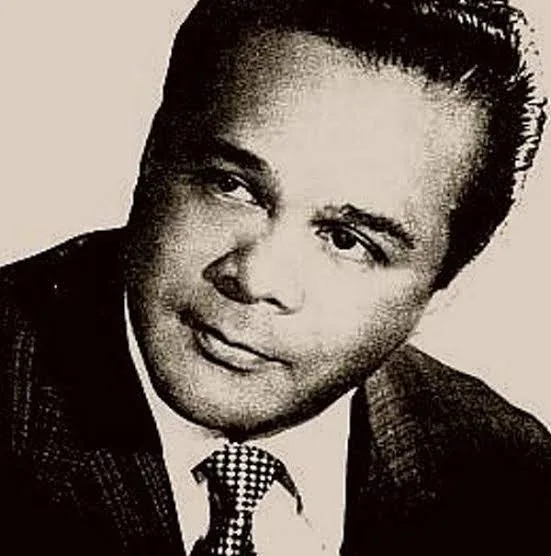
Ignacio de Loyola Rodríguez Scull, known as Arsenio Rodríguez, was born in 1911 in Güira de Macurijes, Matanzas. As a child, he went blind after being kicked in the head by a horse. As a teenager, he began making music.
He joined the Boston Septet in 1936, which was directed by his cousin Jacinto Scull. In 1938, Arsenio founded the Bellamar Septet. Its members were: José Interián, director and trumpet; Esteban Regueira, guitar and second voice; Arsenio Rodríguez, tres; Luis Regatillo, double bass; Manuel Manrique (Moro), lead vocals and maracas; Mario Carballo, bongos; and José R. Ortiz, singer.
She performed with this group at the Sport Antillano dance academy. During this period, she recorded an album with the Casino de la Playa orchestra and played at the Sans-Souci cabaret with Tommy Dorsey's band. At the Tropicana (Calle 72 No. 4504, Marianao, Havana City), she worked with Woody Herman.
In 1940, Arsenio organized the ensemble that bears his name, with himself as its director. Arsenio and his group debuted at the Eden Concert and the Sans-Souci.
The group initially included prominent musicians such as Lino Frías, Rubén Calzado, Nilo Alfonso, and Israel Rodríguez, among others. Over time, artists such as Adolfo O'Reilly, Rubén González, Félix Chappottín, Oscar Velazco (Florecita), Félix Alfonso Vidal (Chocolate), and many others have also been part of it.
Arsenio Rodríguez and his ensemble made significant contributions to the development of Cuban music, such as expanding the instrumental format by adding a piano, three trumpets, and the conga drum to the septet. He also contributed a new repertoire and a greater variety of rhythms and harmonic concepts that enriched not only Son, but also genres like Bolero, Guaracha, and combinations such as Bolero-Mambo and Bolero-Cha.
His ensemble was one of the first and most important Son ensembles, having given the genre a new character. Three important aspects of it should be mentioned. He created a new style of playing the tres, different from that of the Son sextets and septets of the time. He introduced the blending of the piano and the tres, and the harmonic figures enriched this aspect, as did the arpeggios and "tumbaos." The trumpet played by Félix Chappottín stands out, with his distinctly Cuban improvisations. Arsenio Rodríguez's ensemble marks the beginning of the evolution of Son.
Arsenio traveled to the United States, where he settled in New York City in the 1950s. There he continued working on his music, creating other ensembles that included singers like Bobby Capó, Cándido Antomatei, and Santiago Cerón (Sandi). He recorded new albums, primarily for Tico and Blue Note. He was a prestigious figure in the development of Latin American and Caribbean dance music in New York and Los Angeles.
With composer and orchestra conductor Mario Bauzá, he traveled to Copenhagen, Switzerland. In New York, he recorded with Kenny Clarke, who played the tumbaos usually performed on the conga drums; he also recorded with Dizzy Gillespie, Bobby Richard, Al Blake, Max Roach, and Al Taylor.
In his last concert, held in Central Park in New York, he premiered a new rhythm which he called quindembo, in which he used, in addition to the instruments of his former Ensemble, the yuka drums, while the texts of the pieces performed were in the conga language.
Arsenio Rodríguez, also known as El Ciego Maravilloso (The Marvelous Blind Man), became one of Cuba's most renowned bandleaders. He was also a prolific composer, writing nearly 200 songs. His pieces are often humorous and full of double entendres. In his works, he explored Afro-Cuban rhythms and highlighted the prominent role of the tres guitar within the ensemble. He was considered an innovator of his time, skillfully fusing various musical genres to achieve a unique style that is still talked about today.
Among his most popular songs are: Bruca manigua, Mami, me gustó, La vida es sueño and El reloj de Pastora.
Arsenio died in December 1971, in Los Angeles, United States.